The Task
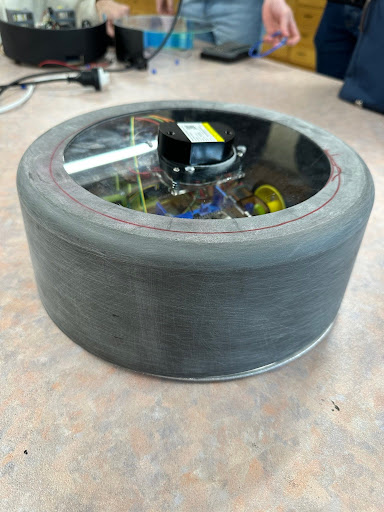
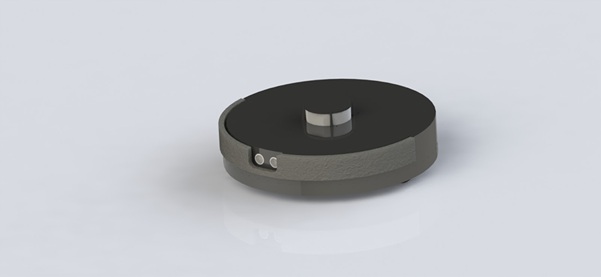
The brief was to develop a fully functional prototype of the autonomous navigation system for a domestic robot vacuum — a circular robot no larger than 300mm in diameter and 85mm tall, under 3kg, with more than an hour of runtime, built to a $500 prototyping budget and designed with sustainability and repairability as core requirements alongside its navigation capability.
Process
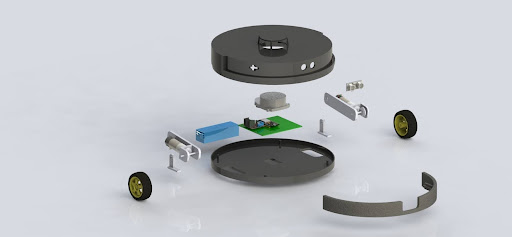
Design concepts were evaluated using a scoring matrix and SCAMPER analysis to weigh options against cost, safety, and performance. Radar was ruled out early on cost and safety grounds, in favour of a scanning LiDAR module paired with an HC-SR04 ultrasonic sensor for fast frontal obstacle detection, two analog cliff sensors on the underside, and a mechanical bumper as a last-resort fail-safe.
Navigation was built around SLAM (simultaneous localisation and mapping): the LiDAR builds a 2D point map of the environment, matched against encoder data from the drive motors to track the robot's position and plan an efficient cleaning route. The drivetrain uses two 75:1 geared DC motors with encoders, controlled through an L298N motor driver.
An ESP32 was chosen as the system's microcontroller for its processing power, cost, and built-in WiFi for remote communication and control. All of this — the ESP32, sensors, a buck converter for regulated power, and a safety power switch — was brought together on a custom PCB designed in Altium, laid out compactly to leave room inside the chassis for the vacuum's suction hardware. The mechanical design was modular by intent, making individual parts easy to repair or replace rather than discarding the whole unit.
Result
The team delivered a complete, validated design — finalised specifications, a working PCB layout, and CAD models of the chassis and drivetrain — that met all size, weight, budget, and safety constraints, ready to move into physical prototype construction. It was a solid exercise in balancing sustainability, cost, and technical performance across a genuinely cross-disciplinary electronics, embedded, and mechanical design.